



Certified Independent Director · Noida, India

Building the ground floor of corporate trust.

Dr. Pushpendra Kishore Mishra has spent 23+ years acquiring, building and governing the physical footprint of one of India's largest banks — 2,300+ branches, and the compliance frameworks that keep them standing.

23+
Years in banking real estate & infrastructure
2,300+
Branches & offices acquired, built, operationalised
₹220 Cr
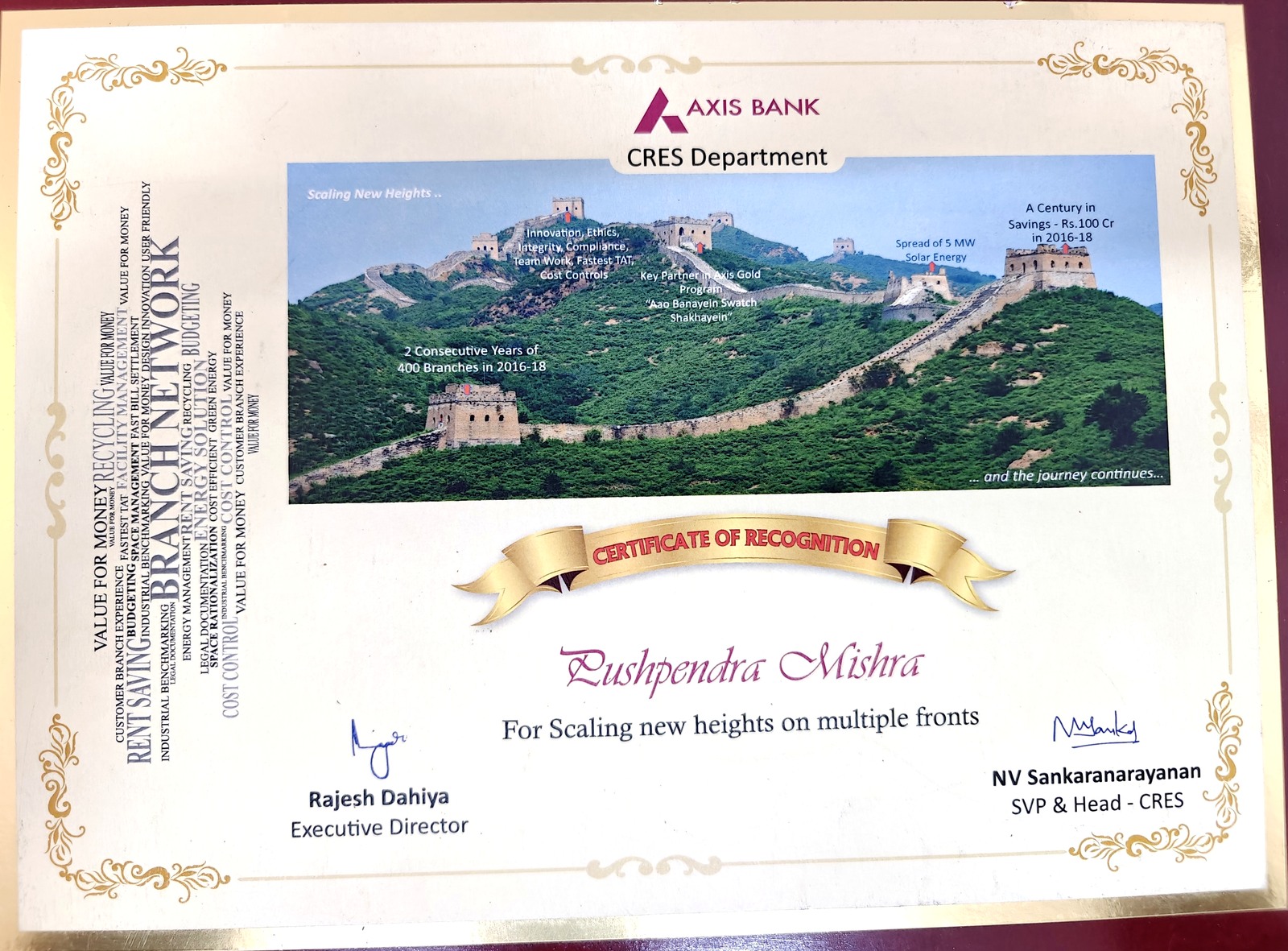
Annual savings delivered through rent rationalisation
352 ac.
Land parcel acquired, Greater Noida
01

About

A career built on the belief that where a business operates is a governance decision, not just a real estate one.

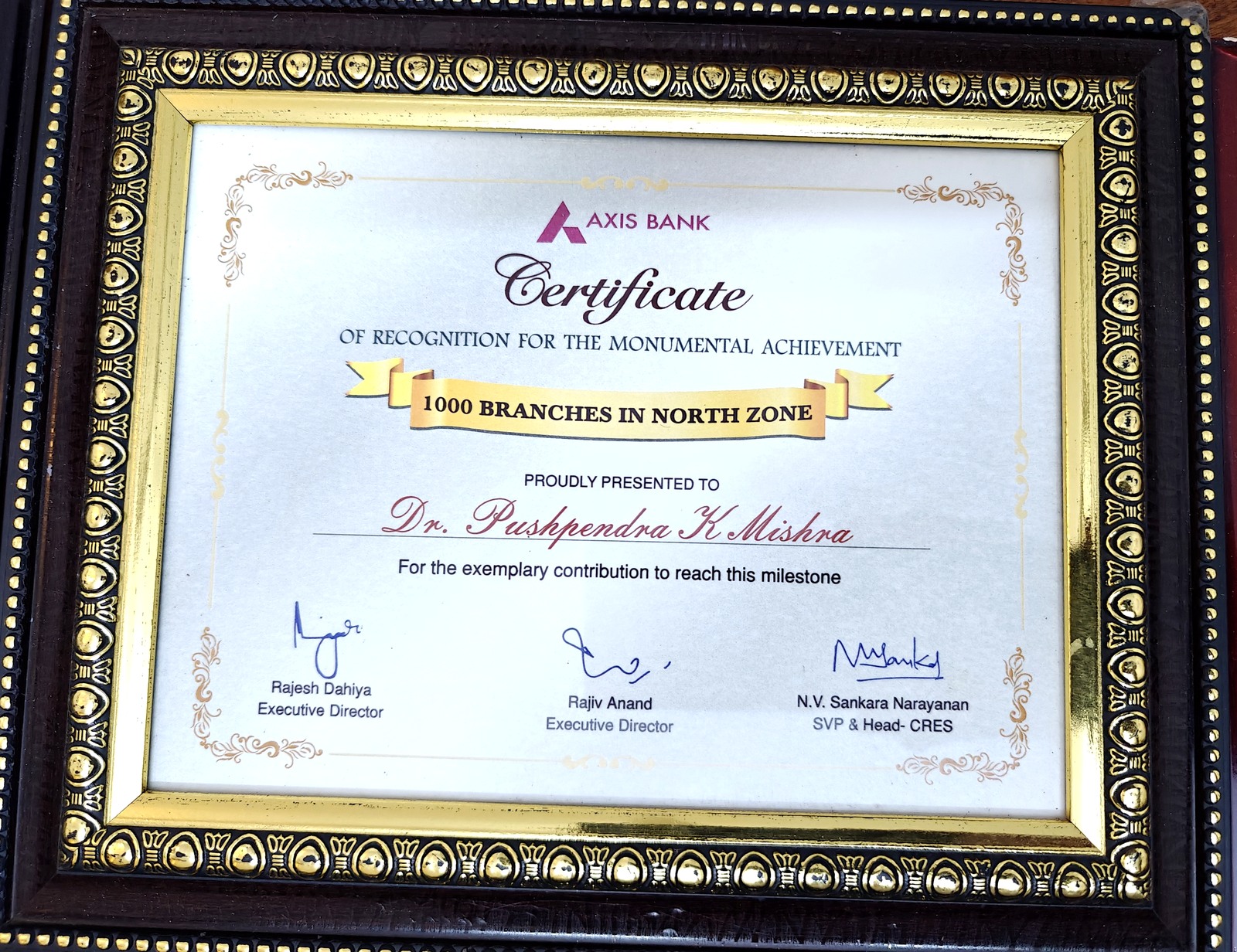
Dr. Mishra leads large-scale corporate real estate and infrastructure programmes for the banking sector — directing the full lifecycle from site selection and acquisition through legal due diligence, layout, contractor management and operational readiness. His portfolio includes marquee acquisitions such as AXIS House, Noida, and a 352-acre mixed-use land parcel in Greater Noida.

As a Certified Independent Director (Institute of Corporate Affairs, Ministry of Corporate Affairs, Government of India), he now brings that same operational rigour to boardroom governance — risk, compliance, and process re-engineering viewed through the lens of someone who has actually built and run the assets in question.

He is currently pursuing the Senior Management Programme at IIM Ahmedabad, building on executive education from Columbia Business School and MIT, and holds a Ph.D. in Management on Mergers & Acquisitions in the Indian Banking Sector.

02

Career Record

2025 — Present

IIM Ahmedabad

Senior Management Programme
On a career development break to complete this executive programme, following earlier leadership education at Columbia Business School (2016) and MIT Management Executive Education (2017).
Nov 2022 — Mar 2025

Axis Bank Ltd.

Senior VP & Zonal Head — Delivery Services, North
  • End-to-end project leadership across North India, from site identification to operational readiness
  • Monetised surplus space across two towers of Axis House, Noida
  • Led infrastructure integration for the Citi Bank merger (LD1/LD2 due diligence)
  • Digitised lease acquisition, renewals and relocations via the Samadhan platform
Apr 2017 — Oct 2022

Axis Bank Ltd.

Vice President — Zonal Head, Ahmedabad / Lucknow / Noida
  • ₹220 Cr annual savings through rent renegotiation and space rationalisation
  • Sustained branch operations through COVID-19; ₹175 Cr saved over remaining lease terms
Jun 2015 — Mar 2017

Axis Bank Ltd.

Deputy VP — Zonal Projects, North / Zonal Head, Ahmedabad
  • Acquired 352 acres of mixed-use land and a 12.74 lakh sq. ft. building in Noida & Greater Noida
  • Led legal, financial due diligence and municipal approvals
Aug 2007 — Jun 2015

Axis Bank Ltd.

Deputy Manager → Assistant Vice President, Zonal Projects, North
  • Opened 300 rural unbanked branches across Punjab, Haryana, Rajasthan, Uttarakhand, J&K and Uttar Pradesh
  • Secured government approval for a bank ATM within the Ellora Caves, Maharashtra, with ASI and the Ministry of Law
2003 — 2007

Walsons Services / APS University / Softechline Solutions

Valuation, Finance Faculty & Financial Analysis
Property valuation and ERP implementation at Walsons Services; finance faculty at Awadhesh Pratap Singh University mentoring 25+ research projects; financial & feasibility analysis at Softechline Solutions.
03

Areas of Expertise

Acquisition

Property & Land Acquisition

Sourcing, due diligence, and negotiation of commercial properties and large land parcels.

Portfolio

Multi-Location Portfolio Management

Compliance with RBI, municipal and corporate standards across thousands of sites.

Execution

Infrastructure Delivery

Site selection through MEPF and contractor management to operational readiness.

Finance

Cost & Rent Optimisation

Annual and interim planning that has driven hundreds of crores in savings.

Governance

Risk & Regulatory Compliance

Liaison with regulators and government authorities; proactive risk mitigation.

Leadership

Process Re-Engineering

Standardised procedures and digitisation that remove bottlenecks at scale.

04

Certifications

Certified Independent Director

Institute of Corporate Affairs (IICA), Ministry of Corporate Affairs, Government of India

Senior Management Programme

Indian Institute of Management, Ahmedabad — currently pursuing

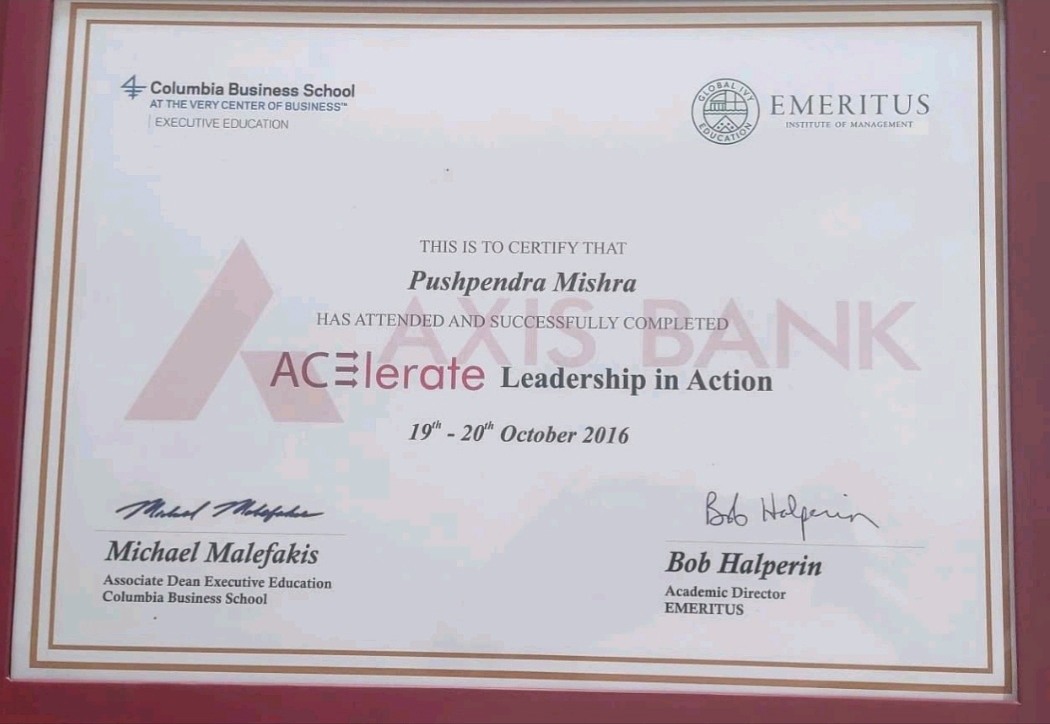
Accelerate Leadership in Action

Columbia Business School — October 2016

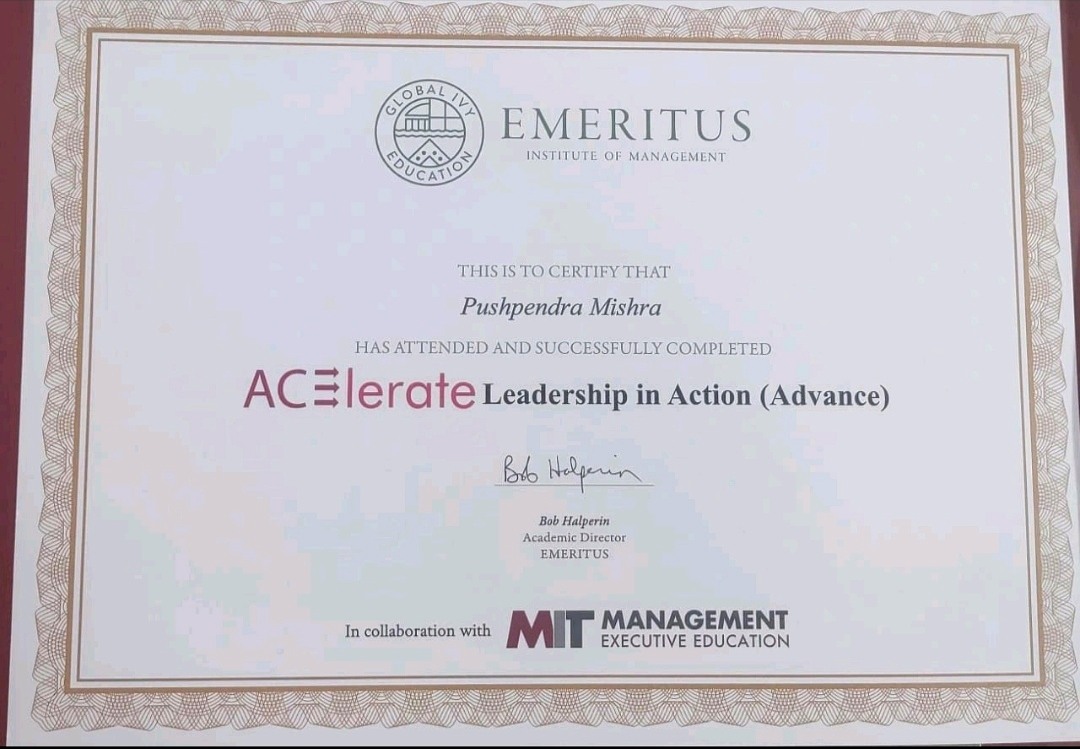
Accelerate Leadership in Action (Advanced)

MIT Management Executive Education — January 2017

2006–11

Ph.D. in Management

Mergers & Acquisitions in Indian Banking Sector — A.P.S. University, Rewa

2001–03

MBA, Finance

Govindram Seksaria Institute of Management & Research, Indore

1998–01

B.Com.

T.R.S. Excellence College, Rewa

05

Impact, by the Numbers

01
Branches & offices acquired, developed and operationalised across India
2,300+
02
Annual savings from rent rationalisation, Ahmedabad/Lucknow/Noida zones
₹220 Cr
03
Total lease-term savings secured during COVID-19 continuity response
₹175 Cr
04
Mixed land-use acquisition, Noida & Greater Noida
352 ac.
05
Rural unbanked branches opened across six North Indian states
300
06
Rent optimisation savings, single-cycle programme
₹10.5 Cr
06

Insights

Aug 2026
The Real Estate Function Is a Compliance Function
Why every branch a bank opens is, first, a regulatory decision — and what that means for how the property function should be structured.
+

In most organisations, real estate is treated as a facilities problem: find a location, negotiate a lease, fit it out, move in. In banking, that framing misses the point entirely. Every branch, ATM, or back-office site a bank opens carries RBI licensing conditions, municipal approvals, fire and safety certifications, and audit trails that will be tested for the life of that lease. The property function isn't downstream of compliance — it is compliance, expressed in square footage.

Over two decades of building and running bank real estate portfolios, the pattern is consistent: the branches that cause problems years later are almost never the ones with bad footfall. They're the ones where a shortcut was taken at acquisition — a title that wasn't fully cleared, a municipal no-objection certificate that was "in progress," a lease clause left ambiguous to close the deal faster. Those shortcuts don't disappear. They resurface as audit findings, regulatory notices, or expensive renegotiations, usually at the worst possible time.

The fix isn't more paperwork. It's structuring the acquisition process so that legal, financial, and regulatory scrutiny happen before a site is committed to, not after — with the same rigour a credit team applies to a loan. Sourcing and negotiation move fast; due diligence should not be the variable that gets compressed to hit a timeline. A property team that understands this builds a bank's physical footprint the way a good credit function builds its loan book: assuming every asset will be scrutinised, because eventually, it will be.

For boards and senior leadership, the practical takeaway is this: real estate risk should sit on the same reporting line as operational and regulatory risk, not buried inside a facilities budget. It rarely does — and that gap is where most of the expensive surprises come from.

Aug 2026
What Rent Rationalisation Actually Looks Like at Scale
Delivering ₹220 Cr in annual savings across a branch network isn't one negotiation — it's a system. Here's how the system works.
+

When people hear "rent rationalisation," they picture a tougher negotiation with a landlord. That's part of it, but at the scale of a national branch network — thousands of leases, hundreds of landlords, dozens of jurisdictions — the real savings come from treating the portfolio as a single system rather than thousands of individual deals.

The first step is visibility most organisations don't have: a live, comparable view of rent per square foot against local market rates, lease expiry dates, and space utilisation, updated continuously rather than reconstructed manually before each renewal. Without that, every renegotiation starts from a weaker position — you're arguing without knowing whether the current rent is even out of line with the market.

The second is sequencing. Leases don't renew on a schedule that's convenient for a renegotiation programme; they renew whenever they renew. Building a rolling calendar of upcoming expiries, sorted by savings potential rather than just chronology, lets a small team focus negotiating effort where it will actually move the number — rather than spreading equal attention across a portfolio where most of the value sits in a fraction of the sites.

The third, and most underrated, is space rationalisation: not just paying less for the same space, but questioning whether the space is still the right size and shape for how the branch is actually used. Post-pandemic banking, in particular, opened up real opportunities here — footfall patterns changed permanently in many locations, and portfolios that hadn't been re-measured against that reality were paying for space built for a branch model that no longer existed.

None of this is glamorous. It's spreadsheets, site visits, and a lot of unremarkable negotiations. But run as a system rather than a series of one-offs, it's where nine-figure annual savings actually come from.

Aug 2026
Why Boards Need Directors Who Have Built, Not Just Reviewed
Governance experience and operational experience are usually treated as separate tracks. They shouldn't be.
+

Independent director training, quite rightly, focuses on fiduciary duty, risk oversight, and governance frameworks. What it can't fully teach is what a decision actually feels like from the operating side of the table — the pressure to hit a timeline, the temptation to treat a compliance step as a formality, the way a "minor" shortcut in execution compounds into a major problem years later.

Having spent a career acquiring land, negotiating leases, and running infrastructure programmes inside a regulated institution, the questions that matter most in a boardroom often aren't the ones on the standard checklist. They're questions like: was this due diligence actually completed, or just documented as complete? Does this cost-saving initiative shift risk somewhere it hasn't been priced? Is this timeline realistic, or is it going to quietly compress the steps that protect the organisation?

Those aren't questions a governance framework generates on its own — they come from having been on the other side of similar pressure, and knowing where corners actually get cut when nobody's watching closely. That's the case for boards deliberately including directors with deep operational and functional backgrounds, not only those with financial or legal governance expertise. Oversight is sharper when at least some of the people providing it have direct experience of what's being overseen.

This isn't an argument against traditional governance expertise — it's an argument for balance. A board built entirely from career directors and a board built entirely from career operators both have blind spots. The strongest ones combine both, and treat operational depth as a governance asset in its own right, not a secondary qualification.

07

Contact

Open to senior leadership and independent director opportunities in corporate real estate, governance and infrastructure.